Showing posts with label caterpillars. Show all posts

Vacation time soon - Quick update

I will be leaving on vacation in a couple days from July 22 - July 30, going to Indiana to pickup my son and visit family. In the meantime, I'm trying to finish up my remaining Monarchs, there are 12 chrysalis left. I purchased a 24" high net castle enclosure from LiveMonarch.org, a not-for-profit foundation in Florida. They also have a professional sanitizing spray that actively kills all bacteria, mold, mildew, single cell organisms, and even viruses. If your ready to raise a bunch of caterpillars, these are essential products to own.

Here are some interesting resources about rearing Monarchs:

Live Monarch - Free Milkweed Seed / Rearing Supplies
http://www.livemonarch.org/

Monarch Watch - Forum and Online Store
http://www.monarchwatch.org/

Monarch Butterfly Migration Tracking Project
http://www.learner.org/jnorth/monarch/

Gardenweb Butterfly Garden Message Board
http://forums.gardenweb.com/forums/butterfly/

Tobacco Hornworms on Nicotiana

We have two Nicotiana plants, also known as flowering tobacco, being raided by the tobacco hornworm. Want to know how to tell the difference between a Tobacco Hornworm and Tomato Hornworm?

The tobacco hornworm is generally green with seven diagonal white lines on the sides and a curved red horn. The tomato hornworms have eight V-shaped marks on each side and their horn is straighter and blue-black in color. These hornworms are the larvae of hawk or sphinx moths.

The plants were cutback today to promote new growth and I'll probably spray later this evening with Southern Agriculture Thuricide, a product that contains Bacillus thuringiensis (BT). I used BT a month ago and with one treatment it worked very well to get rid of the caterpillars. The trick is to spray in the evening because BT degrades quickly in sunlight.

Monarch Butterfly - Fun Facts

Found (2) more Monarch eggs outside so now a total of 9 caterpillars I'm caring for. One formed a chrysalis last night and will be emerging in 9-10 days. Here's some fun facts about the Monarch butterfly!

- The milkweed plant is the only thing the larvae will eat. Did you know that milkweed plants are being cut down to make roads and houses and the monarch butterfly population is decreasing because of this?

- Eastern populations winter in Florida, coastal areas of Texas, and Mexico. They return to the north in spring. Monarch butterflies follow the same migration patterns every year.

- Not all monarchs migrate back north. It appears that the monarchs that migrate to Florida may just stay there, making this population what is known as a “sink population".

- Did you know that monarch butterflies are poisonous? They won’t harm humans, but the chemicals from the milkweed plant that they eat when they are in the larvae stage builds up inside of them and gives them a poisonous defense against predators like frogs, birds, mice and lizards.

- Did you know that monarch butterflies go through four generations each year? The first three generations hatch from their cocoon state (also known as the pupa or chrysalis state) and live for up to six weeks, but the fourth generation continues to live on for up to six or eight months so that they can migrate to a warmer climate, hibernate, and then start a new first generation in the spring time.

Monarch Butterfly - Video Share

Here's my video I wanted to share of the Monarch Butterfly I raised. The papertowel it's walking on is soaked with sugar-water. I only kept it for a couple days as I wanted to release it outside so it could continue it's natural cycle.


Monarch Caterpillar - chrysalis to butterfly

It only took a couple days for the Monarch caterpillar to form a chrysalis on June 5th. Then just 9 days later, a new Monarch butterfly emerged from the chrysalis. To feed to butterfly, I made a sugar-water solution and soaked a piece of papertowel. After a few days of enjoying the butterfly, it was released so it could continue it's lifecycle. Below are pictures of the Monarch chrysalis and butterfly feeding off of the papertowel.

During the past week or so, I've been finding more and more Monarch eggs and tiny caterpillars on our Milkweed plants. I also noticed alot of them disappearing after a few days, which I think is caused from their natural predators like spiders, wasps, and lizards. It's not uncommon for less than 10% of them to survive. So in an effort to help out the Monarch population, I collected some more eggs so I can hatch and raise them to an adult butterfly. Right now I have 7 caterpillars. Three of them just hatched today. The Monarch caterpillar cycle only takes about 2 weeks so it's amazing to watch how fast they grow in a single day. The last picture posted here is one I took of a Monarch laying an egg on the underside of a leaf. I was just planting some more Milkweed plants one day and this Monarch was flying around me the whole time.


Monarch Caterpillar - WOW!

Today I found a gorgeous Monarch caterpillar chewing on our Butterfly Weed plant. First time I've seen one of these caterpillars in our garden because they are only attracted to Milkweed. The Butterfly weed I found it on was just purchased this year. I'll raise this one and post updates. He's already pretty large so it shouldn't take too long before it forms a chrysalis. Once it forms a chrysalis, it's only about 10 days before an adult Monarch butterfly emerges. Most adult Monarch butterflies can live from 2 to 6 weeks! I took this picture below to show you the size and stunning color of this eye catching caterpillar. Simply amazing

Pest Update - Spider mites & Caterpillars

Hibiscus (spider mites) - Today I noticed several yellowing leaves on a hibiscus plant that was otherwise doing very well. To make sure, I inspected the underside of the leaves closely and found a few spider mites. Good thing I looked! The infestation isn't very big, but I want to "shock and awe" them to prevent a larger problem like last year. Last year was horrible, the infestation was so bad, the hibiscus plants were practically sticks because all the leaves fell off. Well that was last year, so this year I'm bringing out the big guns, Forbid 4F. Last year I purchased a small 5ml bottle of Forbid 4F on eBay and this is the first time I have a chance to use it. It's a highly recommended product that offers knockdown and residual control of all kinds of mites and whiteflies. I guess the boy scout in me always wants to be prepared. =)

Nicotiana (caterpillars) - Another round of inspection led me to the Nicotiana plants, which haven't been blooming for awhile. I immediately knew something was wrong when I noticed small feces all over the leaves and blooms hollowed out. It only took a few minutes to find many caterpillars all over the plants, mostly at the tips of new growth. Not sure what species of caterpillar they are. They were eating the inside of flower buds mostly. A quick trip to Home Depot and I purchased some Southern Agriculture Thuricide, it's a product that contains Bacillus thuringiensis (BT). BT does not kill on contact, but rather must be eaten by the caterpillar to be effective. After a day or two, the caterpillar stops eating and dies. BT cannot be applied during daytime hours as it degrades rather quickly in direct sunlight, so applying in the late evening is best. BT is also safe for beneficial insects, birds, and animals.

Final Update - Polyphemus Moth hatched

Happy New Year's Eve! Exactly 7 weeks have passed since the cocoon was made, and finially emerged a Polyphemus Moth. Beautiful design on the wings, with streaks of pink and very distinct eyes. Truely a sight to admire. Though I'm glad I eventually only raised one caterpillar since the moth is rather big, but it was a very interesting experience. All together it took just under 3 months from egg to moth! I released it the following day on January 1st so it can continue it's life cycle.


Update - Polyphemus Moth caterpillars

It's been about 6-7 weeks since those Polyphemus moth caterpillars hatched from their eggs. They've been eating alot and growing fast everyday. I started with over 20 larvae, but since I couldn't keep up with the amount of leaves they were all eating, I decided to release several outside. Now I'm raising just 1 single caterpillar and it has finially formed a cocoon!


Update - Polyphemus Moth caterpillars

It's been 18 days since the larvae hatched out of those strange eggs
(see previous post here)

I originally had about 25 larvae, but they were eating so much that I had to keep refilling the oak leaves in the jar. So I released several and now I'm raising 4 caterpillars. I've read they get about 2 inches long before they start to form cocoons. Right now they are a little over an inch long. Will update again in a couple weeks!


Mystery eggs and larvae - Polyphemus Moth

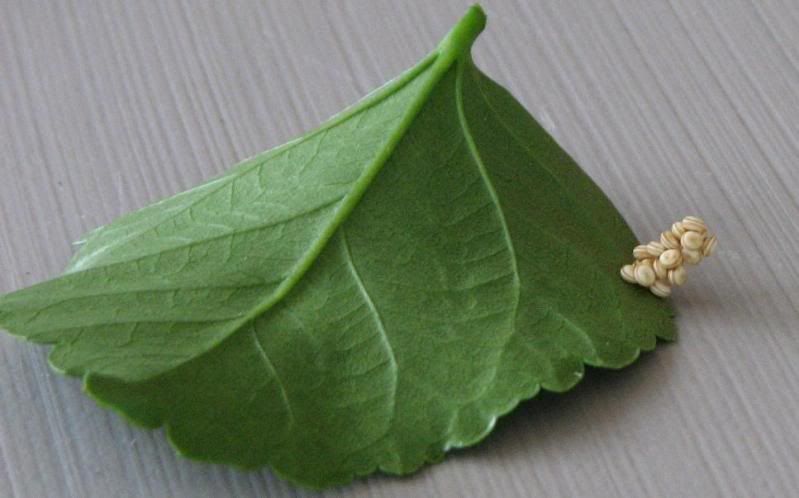
Found some unusual egg capsules under some Hibiscus leaves, so I collected them and put them in a jar to hatch. Below is a picture of the eggs..

Photobucket

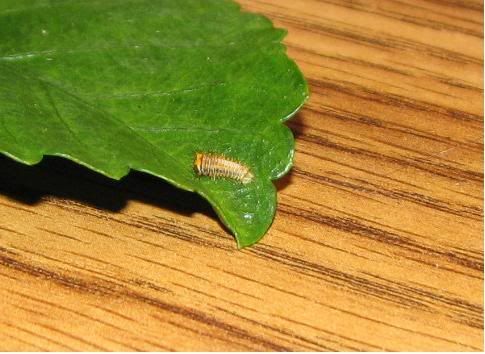
After a few days, the eggs hatched into tiny larvae that looked like caterpillars...

Photobucket

Very hard to identify these larvae, but after some research on Google, I learned the same eggs and same larvae belong to the beautiful Polyphemus Moth. The website below shows more detailed pictures on the lifecycle of this particular moth.

Website on the Polyphemus Moth

I'm feeding the newly hatched larvae oak leaves and there are about 20 babies in a jar right now. Will update as they get grow bigger. =)