Showing posts with label birds. Show all posts

Backyard Birds Fall 2011 Update

In this post I will briefly update the birds we've seen in our backyard recently.

First I'll start with the year-round residents who seem to have found a local home here. The most common bird around our feeders are the Mourning Doves. At least 2-3 visit everyday, while some days I see up to 8 or 9 doves fighting over a spot to eat.

Photobucket

The Tufted Titmice are still here, usually in small groups of 2 or 3. I can always tell when a hawk is in the area since these titmice are very vocal to alert others of a possible threat.

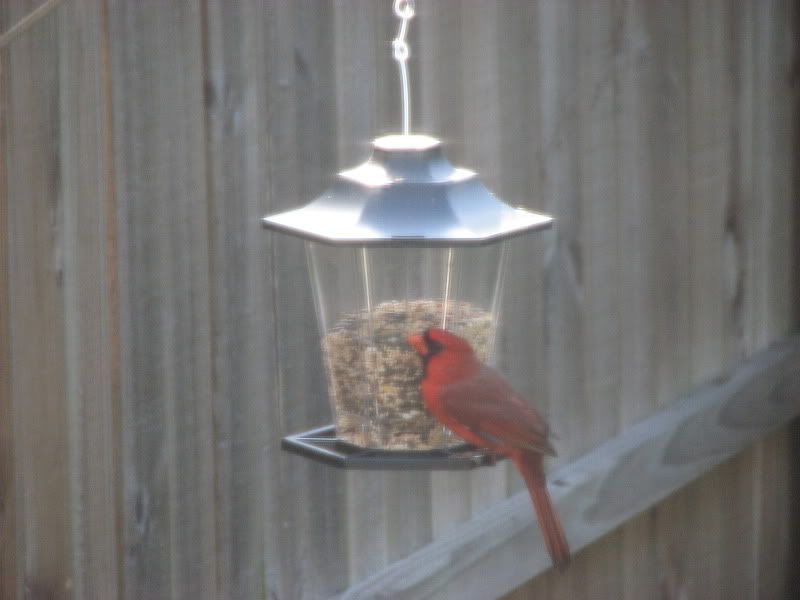
The male and female pair of Cardinals are still here too. They usually travel together and occassionally the male will feed the female.

My favorites are a couple of Black-capped Chickadees that seem to travel with the Tufted Titmice often. These small chickadees are the most adorable birds ever, and their calls are even more adorable.

And finially here's a female Painted Bunting that recently showed up since the first cold snap that hit our area last week. I remember seeing these birds last fall/winter, so I'm pretty sure they are migrating from the north.

Photobucket

Florida Mockingbird Nest with Four Babies

Yesterday while doing some outdoor chores, we found a Florida Mockingbird nest inside a Robellini palm tree in our front yard. There are 4 baby mockingbirds inside the nest, still very young with their eyes shut.

Here's some info about the Mockingbird nesting habits. The nest is constructed by both the male and female, though the male does most of the work while the female perches close-by watching out for predators. Three to five eggs are laid by the female and then she incubates the eggs for about 11 to 13 days. Once the eggs are hatched, both parents are responsible for feeding the baby chicks for about 12 days. So the entire timeframe from incubation to fledging is 23 to 25 days.

The parents will aggressively protect their nest and surrounding area against other birds and animals. When a predator is persistent, mockingbirds from neighboring territories, summoned by a distinct call, may join the attack. Other birds may gather to watch as the mockingbirds harass the intruder. In addition, it is not unheard of for mockingbirds to target humans. They are absolutely unafraid and will attack much larger birds too, even hawks. I've actually witnessed this a few days ago as two mockingbirds chased away a hawk from a tree.

Cardinals Nesting

A pair of cardinals have recently made a nest at my sisters new house. The nest is easily visible outside a dining room window where a small tree grows. Here's a few pictures of the female cardinal nesting in her new home..

Photobucket

Photobucket

Ruby-Crowned Kinglet sighting

Here's another winter migration bird, the Ruby-crowned Kinglet, one of the smallest songbirds in North America. Found this one while I was outside refilling the bird feeders. This one is a female because it lacks the ruby crown. Their breeding habitat is in the forests across Canada, Alaska, and western United States. They then migrate to the southern United States and Mexico. While observing this bird I was hearing this unusual wing flicking sound during flight, and apparently this is common with Kinglets. It was attracted to our American Beautyberry plants which now have gorgeous bright purple berry clusters all over them.

Hard Freeze & winter migrating birds

The winter migration is on and we have some company. No it's not my family visiting for the holidays, I'm talking about a small "tournament" of Chipping Sparrows making a buffet out of our fresh bird seed. There's probably about 6 or 7 sparrows in this group I've been seeing almost everyday. Along with the chipping sparrows, we still have the titmice and cardinals.

Florida is experiencing an unusual hard freeze this early in December, which could mean a very cold and damaging winter in the near future. Last night the temps dropped down to 27-29 degrees for a couple hours here. Factor in the wind chill, and they say it feels like 20 degrees outside. BRRRRR! Several plants are still covered with blankets and my container plants are temporarily sitting in the garage. We're suppose to have another hard freeze tonight! That will make 3 freezing nights so far this season and it's only December 14th. I'm hoping we won't have too many garden casualties due to freeze kill. Though I'm sure the garden shops will be very busy in the spring when floridians will have to replace their landscape.

It's been awhile since I've added a photo so here's one I took today of the chipping sparrows. Enjoy! :)

Bird watching update

Just a quick update on the birds. The male/female pair of Cardinals, about 3 Tufted Titmice and at least 2 Doves still remain in the area. They stop by to feed just about everyday. Since it's been cold outside, I've been keeping a close-eye on the feeders, refilling with more seed if needed so the wildlife can survive the cold nights. Also I wanted to show you all a great video I recorded today of a Tufted Titmouse picking at a sunflower seed.

Bird watching update and new supplies from Lowes

A couple weeks ago I pictured a young male Rose-Breasted Grosbeak that was using our feeder daily for awhile. Unfortunately I haven't seen it in the last couple of weeks so I think it has moved farther south to warmer night climates. Here's whats feeding on our bird seed mix now (black oil sunflower, safflower, milo, white millet, cracked corn):

Small group of Tufted Titmice
Male and Female pair of Cardinals
3 Mourning Doves feeding on the ground

Yesterday I spotted a new bird using the feeder that I believe was a female Painted Bunting. It only stayed for about 10 minutes and I wasn't able to get a clear photo. I've also spotted a single Carolina Wren hanging around every now and then.

Tufted Titmouse on a windy day, so cute!

Caroline Wren sitting on our grill


Today I placed an order for some more bird seed at Lowes and found a great mix in Scotts Colorful Bird Blend Seed. It has it ALL! nyjer seed, safflower, black oil sunflower seed, peanuts, white millet, sunflower chips, canary seed, raisins, red millet, juniper berries. Also grabbed a seperate 10 lb. bag of black oil sunflower seed since I normally mix more sunflower into the feeder mix. Lately squirrels have been eating more seed than the birds, so i'm trying something new with a Squirrel Bungee feeder, hoping to distract them away from the bird feeders with this. If that doesn't work, I bought a Squirrel Guard for the feeder pole. =)

Scotts 8-lbs. Colorful Bird Blend Seed
Garden Treasures 10-lbs. Black Oil Sunflower Bird Seed
Garden Treasures 16" Squirrel Guard
Birdola Squirrel Bungee Feeder and Cake Combo

Rose-Breasted Grosbeak sighting

While watching our bird feeders today, there was a different bird hanging around that we haven't seen before. It took some research, but I learned it's an immature male rose-breasted grosbeak. The immature male is difficult to identify because it resembles the colors of the female. However, you can see the rosey tint on it's chest and black on the wings, which the female doesn't have.

The adult male is absolutely stunning though, a very attractive bird. The link below shows an adult male rose-breasted grosbeak

adult male rose-breasted grosbeak picture

Information on the Rose-breasted Grosbeak


Bird watching...

The small bird feeder in our backyard has been attracting some hungry wildlife. A pair of Tufted Titmouse birds are visiting the feeder everyday, and also a male & female Cardinal are using it frequently.

Photobucket

Red-Shouldered Hawk

Pictured here is an juvenile Red-Shouldered Hawk, the most vocal American hawk. Commonly found in woodlands near water, it can occasionally be found nesting in suburban areas. Found this one sitting on a fence just outside our bedroom window. Just look at those claws!